Eight things that make the country feel like nowhere else.
From Vilnius, do not chase “unique” experiences all over the map. Start with the extraordinary things already near you — ballooning, Trakai, pirtis — then earn the kilometres with Dzūkija or a westbound route.
Not “unique” because marketing said so.
Rule 1: it should feel meaningfully different from what you can do on a generic European city break.
Rule 2: the story matters as much as the photograph.
Rule 3: if something is famous but not worth a special detour, I will say so.
Rule 4: seasonal experiences can be better than permanent attractions. Timing is part of the product.
Experiences that make Lithuania feel like Lithuania.
From Vilnius, the easiest “only here” sequence starts above the city, then moves to Trakai, pirtis and Dzūkija before you spend serious kilometres chasing the western stories.
Fly a hot-air balloon over Vilnius — or let the wind send you to Trakai.
Vilnius is one of the rare European capitals where balloon flights can operate above the city, but the exact launch point and route are not yours to command. Weather, wind direction, visibility and air-traffic clearance decide the real plan; established operators may shift a Vilnius booking to Trakai or nearby.
Plan it properly: keep the half-day flexible and use the water, air & adventure radar for the Plan B logic.
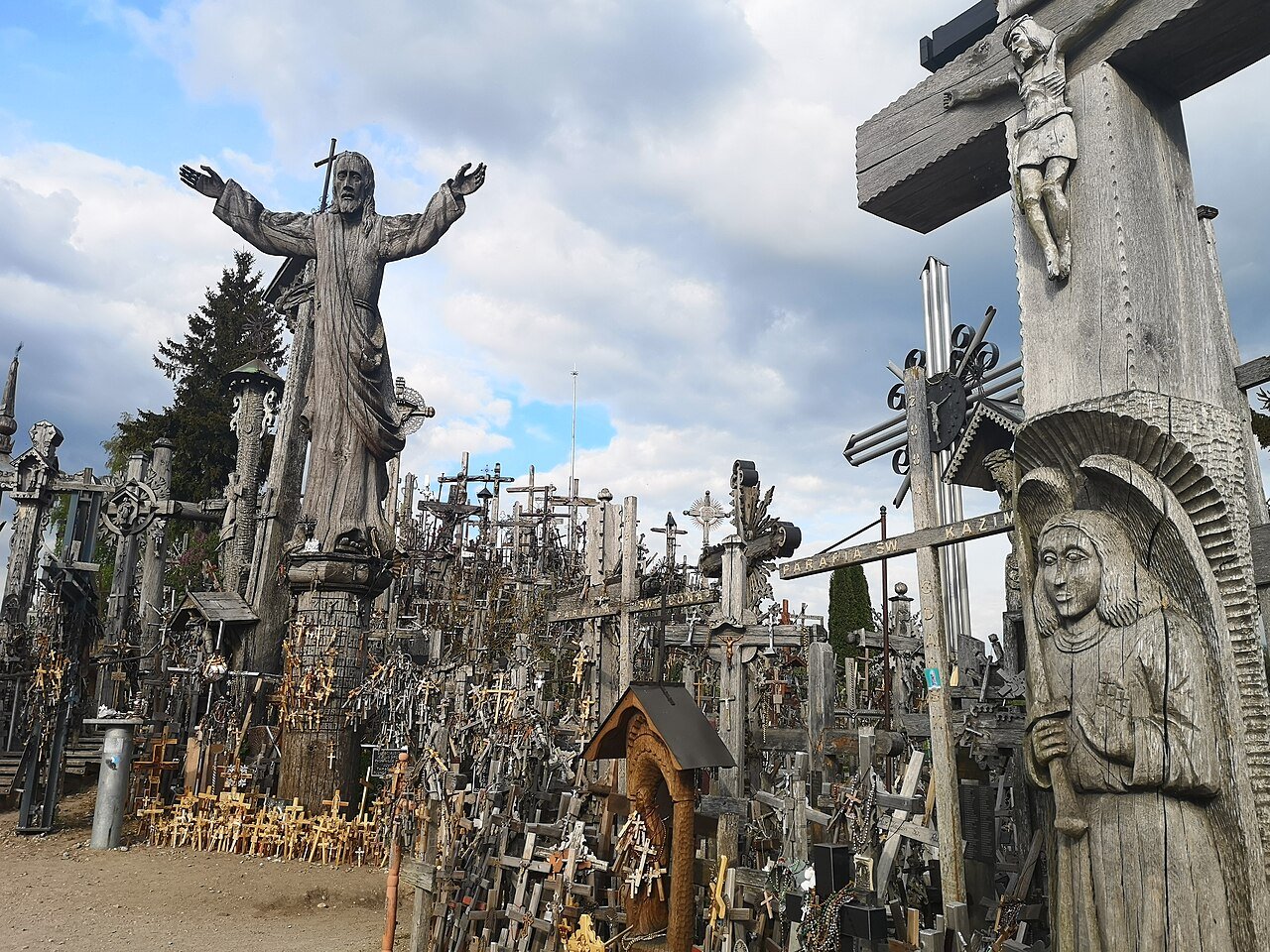
Walk into 200,000+ crosses near Šiauliai.
The Hill of Crosses grew through faith, remembrance and resistance, surviving Tsarist and Soviet repression. It is free, open all year and genuinely unlike a normal monument.
Vytas would: combine it with a westbound route or Šiauliai/Žemaitija. I would not burn an entire short trip driving there and back solely for the pin.
Stand inside a Soviet missile launch complex.
Near Plungė, the Cold War Museum occupies a former underground base where four SS-4 medium-range missiles with two-megaton thermonuclear warheads were deployed from 1963 to 1978, aimed toward Western Europe.
2026 anchor: Lithuania Travel lists tickets from €10 and opening daily 10:00–18:00 in current material.
Do a Lithuanian pirtis, not just “a sauna”.
Steam, medicinal plants, vantos, cold water and long pauses. The experience belongs in the same cultural conversation as Finnish sauna but has its own texture and rituals.
Go mushroom picking in Dzūkija.
Foraging remains so culturally normal that official tourism copy jokes about mushroom picking as a national sport. Do it in season, preferably with someone who knows what belongs in the basket.
Stand on the Curonian Spit between lagoon and Baltic.
A 98 km UNESCO landscape of moving/stabilised dunes, forest and old settlements shared between Lithuania and Kaliningrad. Nida is the base; the landscape is the reason.
Celebrate Joninės and look for a flower that does not exist.
On the night of 23–24 June, bonfires, wreaths, songs and the mythical search for a fern blossom preserve a wonderfully stubborn strand of Baltic midsummer tradition. Ferns, inconveniently, do not bloom.
Hear thousands of people sing when the calendar aligns.
Lithuania's mass song-and-dance celebration tradition is not an annual tourist product, which is precisely why it is powerful when your dates coincide. Treat it as calendar gold, not a checkbox.
Four facts that explain the country surprisingly well.
History, language, ritual and the national willingness to turn soup into an event.
Lithuanian preserves very old Indo-European features.
Tourism material loves comparing Lithuanian words with Sanskrit. Linguistics is more nuanced than “oldest language”, but the survival of archaic grammatical features is genuinely remarkable.
Lithuania has hundreds of hillforts.
The country's pre-Christian and medieval landscape is still physically present in mounds and hillforts, often sitting quietly outside major tourist circuits.
We have institutionalised pink soup enthusiasm.
Vilnius' Pink Soup Fest takes a cold beetroot dish and applies music, costumes, street events and large quantities of pink to it. This is what happens when a country finally stops apologising for being itself.
Cross-making itself is heritage.
The Hill of Crosses is not just a pile of religious objects; Lithuanian cross-crafting traditions are recognised by UNESCO as intangible cultural heritage.
Which “only in Lithuania” should you actually do?
Because eight unique things in four days is still eight things too many.
Balloon + Trakai + pirtis
High contrast, easy from Vilnius/Kaunas, and no need to drive across the country. Add one food night — or one properly chosen night out from Lithuania After Dark — and you already understand more than a checklist tour reveals.
Best 3–4 day mixThis is the compact first-trip hat-trick: scenery, history and one experience that actually changes your pulse. Add a serious dinner and stop. Lithuania does not award points for unnecessary mileage.
Hill of Crosses + Cold War Museum
Faith/resistance and nuclear occupation history in the same westbound route. Much stronger together than as isolated attractions.
Best road-trip pairThe pairing works because the emotional temperature flips completely: private faith and resistance at one stop, industrial-scale Cold War paranoia at the other. Do both; let the road between them reset your head.
Dzūkija + Nida
Forest/river culture in the south and a sea/lagoon dune world in the west. Two landscapes, two different ideas of Lithuanian quiet.
Best 7+ day tripThis is where the country stops looking small. Dzūkija is intimate and wooded; Nida is exposed, engineered and almost theatrical. Give them time — rushing either one defeats the reason for going.
Can you do all of this yourself? Mostly.
DIY: yes — direct tickets, direct operators, public roads, normal accommodation. Weather-dependent balloon flights and regulated nature access simply require sensible booking.
When I help: deciding which of these is worth your limited days, fitting them into one route, and adding context so the day feels like a story instead of seven pins on a map.
What is checked — and what can change.
Core facts and 2026 price anchors checked 26 August 2026. Dynamic accommodation, restaurant and experience prices should always be confirmed before booking.
This is the page that decides whether you go home with a holiday or a story. Basketball treated as a state religion, a self-declared republic with its own constitution nailed to a wall, birch branches used as wellness equipment, and an entire nation disappearing into the woods every autumn for fungi. None of it is staged for you, which is precisely why it works. Do at least two.
PICK: at least two, properly, rather than six in passing · VERDICT: the difference between having visited and having been here
Which of these is actually worth your time?
That is the useful question. The whole list is free. If your trip has four days, children, a rental car or one non-negotiable interest, I can cut eight possibilities down to the two or three that make the journey better.
See how help works →DIY default
Book direct and use the linked guides.
Optional upgrade
I turn “we want authentic Lithuania” into a route that has a beginning, a climax and enough empty space to enjoy it.
FROM THIS PAGE TO THE WHOLE TRIP
One page solves one decision. The Handbook connects the trip.
Twenty chapters join the days, bases, transport, food, destinations and things worth skipping into one offline plan. If you would rather not assemble it yourself, Trip Build applies the same judgement to your dates.
Trip Build and €99 support both include the complete Handbook at no extra cost.