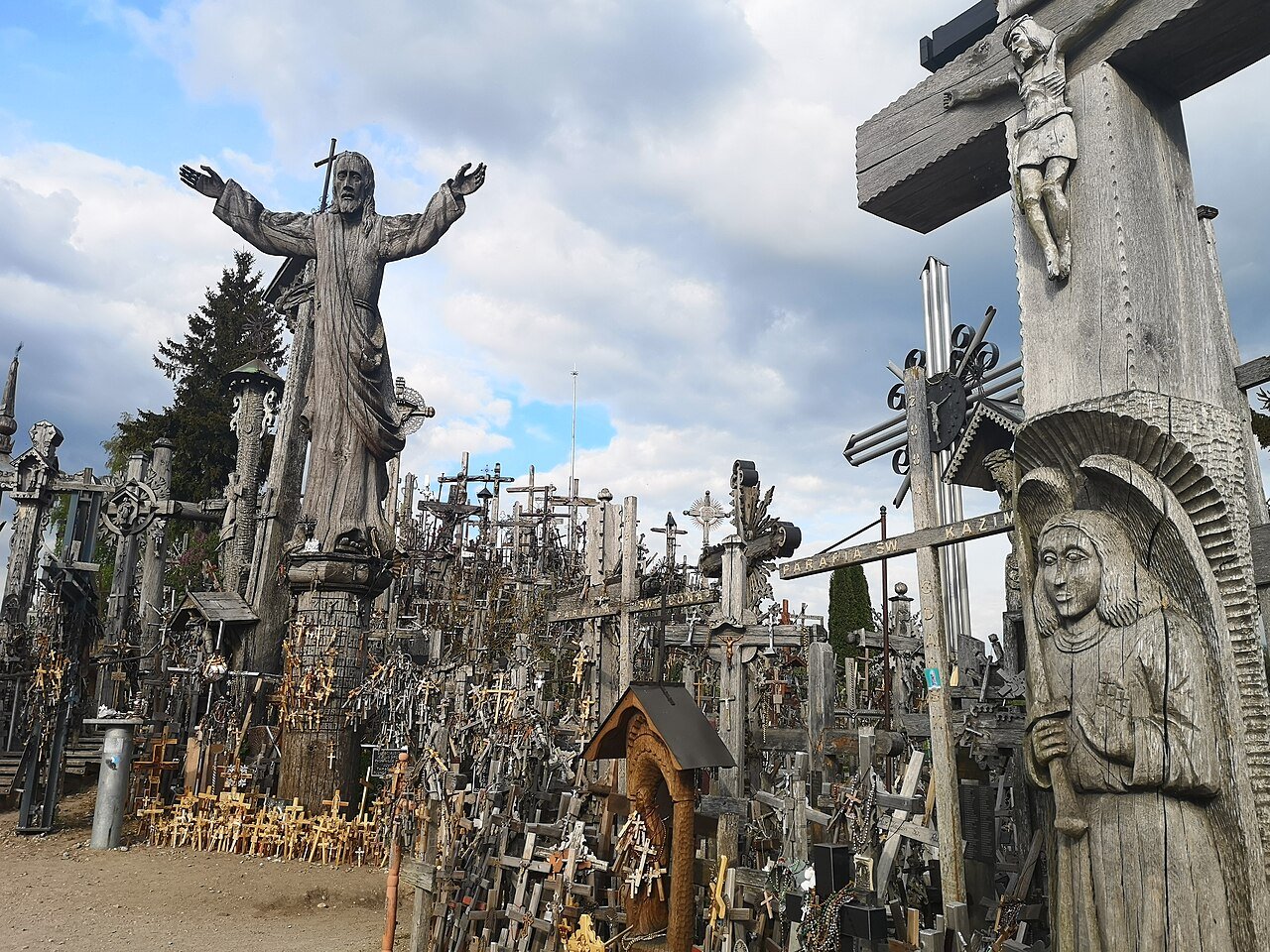
More than a photo
Lithuania Travel describes well over 200,000 crosses. The site grew as a place of commemoration and survived repeated attempts at destruction under repression and Soviet rule.
See it as a living place of faith and persistence, not as “that weird hill from Instagram”. Then decide whether your actual route earns the detour.
The Hill of Crosses is visually extraordinary, but the crosses are not props. It is a living devotional and historical site shaped by faith, resistance, memory and pilgrimage.
Worth seeing? Yes, when your route is already northbound or includes Šiauliai.
As a cross-country mission? Usually no.
Lithuania Travel describes well over 200,000 crosses. The site grew as a place of commemoration and survived repeated attempts at destruction under repression and Soviet rule.
Pope John Paul II’s visit brought international attention, but pilgrimage and the practice of leaving crosses were already embedded in the place.
Walk slowly, keep voices down around people praying, and do not climb into the crosses for a better social-media angle. This is one of those places where basic manners are the whole etiquette guide.
On a northbound Baltic route, Šiauliai day or westbound crossing, the answer can be easy. From the wrong corner of Lithuania it becomes a very long drive to prove that the map was accurate.
The crosses first appeared here in the nineteenth century, after uprisings against Russian imperial rule left families with dead they could not bury and nowhere official to mourn them. That origin matters, because it explains everything the site became later.
Under Soviet rule the hill was levelled by bulldozer more than once and the area sealed off. Each time, people came back at night and planted more. That is the actual story: not the quantity, which is merely startling, but the stubbornness, which is the point. By the time the state gave up, the hill had become the most eloquent piece of passive resistance in the country — a place where refusing to stop doing something small was the entire argument.
Pope John Paul II visited in 1993, which brought international attention, but pilgrimage and cross-planting were long established before that and continue now. People still arrive and add one.
Forty-five minutes to an hour is honest. It is not a large site and there is no interior to work through. The impact is immediate rather than cumulative.
You can buy one at the entrance or bring one. This is not a souvenir transaction; adding a cross is the participation the place is built around, and it is what separates a visit from a photograph.
There is no shelter. In flat northern-Lithuanian wind and rain it is bleak and extraordinary; in sun it is oddly cheerful. Neither is wrong, but dress for the first one.
It sits north of Šiauliai, off the main route toward Latvia — which is why it works so well as a Baltic-crossing stop and so badly as a Vilnius day trip.
People pray here. Some are visiting graves that do not exist anywhere else. Walk the paths rather than through the crosses, keep your voice down, and do not climb the structure for an elevated angle — a request that should be unnecessary and unfortunately is not.
If somebody is clearly in the middle of something private, give them the frame. The photograph will still be there in four minutes.
Go if you are already heading north. Do not cross the country for it. Two hundred thousand crosses on a small hill is genuinely extraordinary, and it is not a novelty: people planted them under a regime that bulldozed the hill and they simply came back and did it again, repeatedly, for decades. It photographs like an art installation and functions like a church, and the gap between those two facts is where most visitors get it wrong.
DETOUR: roughly two hours each way from Vilnius · TIME ON SITE: 45–60 min · VERDICT: yes on a northbound route, no as a mission
Heading to Riga? The Hill of Crosses becomes much more attractive when Riga — not Tallinn — is tonight's target. Our Baltic road guide compares the fast Panevėžys/Bauska line with the more interesting Šiauliai option.
FROM THIS PAGE TO THE WHOLE TRIP
Twenty chapters join the days, bases, transport, food, destinations and things worth skipping into one offline plan. If you would rather not assemble it yourself, Trip Build applies the same judgement to your dates.
Trip Build and €99 support both include the complete Handbook at no extra cost.