Every returning emigrant discovers the same odd thing: you can't explain your own country to people who have already decided what it looks like. For twenty-seven years I lived in Britain and watched perfectly intelligent people — people who could name four Greek islands and rank them — imagine Lithuania as a grey rectangle somewhere near Russia where everyone queues for cabbage.
Then comes the useful question: “Why did nobody tell us about this?” That gap between the mental picture and the country on the ground is the point of this guide.
So. Consider this the telling.
01 — "It's grey and concrete"
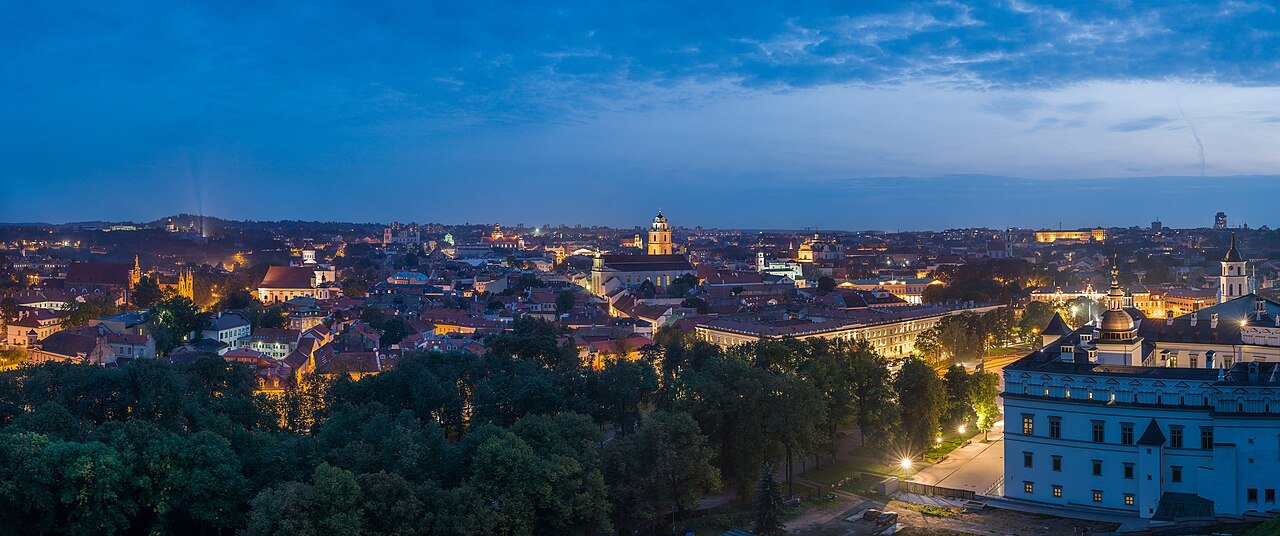
Vilnius has a UNESCO-listed historic centre with a particularly strong Baroque character, warm-stoned lanes and enough courtyards that getting slightly lost is the correct method. Not a slab of concrete in sight, unless you specifically go looking for it.
And you should go looking for it, actually, because Soviet architecture is genuinely fascinating when you know what you're looking at. But it's a side dish, not the main course. The main course is a compact historic city where Gothic, Renaissance, Baroque and Classical layers sit inside a medieval street pattern — UNESCO's description, not mine.
The wider truth: Lithuania is forest-rich and lake-rich; official tourism material puts woodland at roughly a third of the country. The storks remain editorially unquantified.
02 — "Everyone speaks Russian there"
Careful. This one isn't just wrong, it's the wrong thing to say out loud at dinner.
Lithuanian is not Slavic. It is one of the two surviving Baltic languages and is famous among linguists for preserving unusually archaic Indo-European features. Russian remains part of some older generations' linguistic history, but Lithuanian is the state language and English is widely useful in visitor-facing Lithuania, especially in the cities. Do not arrive assuming Russian is the default.
What to say instead: labas (hello), ačiū (ah-choo — thank you), į sveikatą (cheers). Three words, disproportionate returns. Lithuanians expect no foreigner to try, so trying is a small event.
03 — "It's basically Russia"
Lithuania is in the EU, in NATO, in the eurozone and in Schengen. Lithuania restored its independence on 11 March 1990. The famous Baltic Way was a separate act of resistance seven months earlier, on 23 August 1989: a roughly 600 km human chain linking Lithuania, Latvia and Estonia. Keep the dates separate; the story is powerful enough without compressing it.
Going further back: this was once the Grand Duchy of Lithuania, one of Europe’s largest states at its 15th-century height, running from the Baltic to the Black Sea. That's the frame Lithuanians actually carry around. Not "post-Soviet" — that's fifty years of an eight-hundred-year story, and not the chapter anyone here wants to be defined by.
04 — "There's nothing to eat but potatoes"
Partly earned, entirely outdated. Yes, we do things with potatoes that would concern a nutritionist — cepelinai, the zeppelin-shaped dumplings, are delicious and sit in your stomach like a moral decision. Have them once, at lunch, never before a long drive.
But the actual food story now is new-Baltic cooking: fermenting, foraging, smoking, fire. Vilnius now has Michelin-starred kitchens alongside a much broader modern Baltic food scene. There's rye bread that ruins supermarket bread for you permanently, smoked eel on the coast, and šaltibarščiai — the cold, violently pink beetroot soup that is less a dish than a personality test.
My honest position: Lithuanian food is the single most underestimated thing about this country, and the gap between what visitors expect and what lands on the table is where most of the "why did nobody tell us" comes from. Restaurant choice is exactly where local context can save a mediocre “traditional” meal. The public food guide gives you the framework; if you want help narrowing it to your dates and budget, ask and book the restaurant directly.
05 — "It'll be dirt cheap"
This one is wrong in an interesting direction. Lithuania is good value, which is not the same as cheap, and the difference matters.
Many everyday visitor costs can still compare favourably with Britain, but the gap depends heavily on season, neighbourhood and how ambitious you are. But this is a modern EU country: Vilnius rents aren't a joke, the good hotels charge properly, and if you arrive expecting 1997 you'll be confused and slightly rude about it.
The useful reframe: your money buys a better version of things here, not a cheaper imitation. The useful question is not “is it cheap?” but “what quality am I buying for this money?” That is why every major guide here uses a value verdict rather than a bargain badge.
06 — "Is it safe?"
Safety is a reasonable question, but Lithuania is not a destination where visitors should arrive expecting special urban-survival tactics. Use the same ordinary travel judgement you would in other EU capitals; forests, water, ticks and mushroom identification can matter more to an outdoor itinerary than street drama.
Solo travellers, families and older visitors routinely travel independently here. For current official travel advice, use your own government’s Lithuania page rather than a travel-blog adjective.
07 — "There won't be much to do"
The opposite problem, in fact: there's more than five days can hold, and the good stuff isn't signposted. Lakes and kayaks. A sand spit with fifty-metre dunes. Hot-air balloon flights around Vilnius and the Trakai landscape when weather and operating conditions allow. Wooden villages where the silence has texture. Mushroom hunting, which is less a hobby here than an unregulated national sport.
The catch: almost none of it markets itself in English. Some excellent countryside stays, seasonal activities and small local operators are easier to find through Lithuanian directories or direct contact than through the largest international platforms. That gap — between what exists and what is easy to find in English — is one reason this site exists. If you want the decisions narrowed, send the dates and priorities; you still book providers directly.
08 — "The weather will be miserable"
Different, not miserable. Lithuanian summer can be properly warm, but it is still Baltic weather rather than a contract. June brings very long evenings; September is a strong shoulder-season option if you value lower pressure and autumn colour.
Winter can deliver snow, ice and the version of pirtis culture that makes cold-water contrast suddenly logical. Conditions vary by year; never treat a frozen lake as safe without local confirmation.
November is the month I would choose only deliberately: short light, shoulder-season weather and less of the visual drama people imagine when they say “Baltic winter”.
09 — "The sauna is just a hot room"
No. The pirtis is a social institution with rules, and the rules are the point. There will be a person — possibly your host, possibly a stranger with strong opinions — who beats you gently with a bundle of birch branches. This is not a prank. It is called vanta: a traditional bundle used to move heat, scent and touch across the body. It is not a prank, and it does not need medical claims to be interesting.
Three sessions, cold water in between, no rushing, no phones. A proper session is slower and more social than the “sit in a hot room for ten minutes” hotel-spa model. If your trip has one non-negotiable element, make it a lakeside sauna evening — not a hotel spa. There's a difference, and the difference is the whole thing.
10 — The cheat sheet
Nine minutes of prep that fix everything
- Learn three words: labas, ačiū, į sveikatą. Nobody expects it. Everyone notices.
- Never open with "so, Russia…" or "how was it under the Soviets?" — unless someone else opens the door first. Then listen; the stories are extraordinary.
- Cards are widely useful, including contactless public transport in Vilnius; keep a little cash for small rural stops rather than making “cashless” a religion.
- Tipping is not built like the US system. If service warrants it, a modest tip or rounding up is normal; do not turn dinner into a mathematics exam.
- In a private home, follow the host on shoes. Taking them off is common; the civilised move is noticing the room rather than arriving with a constitutional position.
- Cepelinai at lunch, not dinner, and not before driving. Your body will thank you and possibly write.
- Book the sodyba before the hotel. The lakeside houses with saunas are the scarce commodity; Vilnius rooms are not.
- Consider September as well as August. It can trade peak-season pressure for cooler evenings and autumn colour; check the specific coast and activity calendar you care about.
- Bring swimwear in the day bag if lakes are part of the plan. It weighs almost nothing and prevents the most avoidable kind of regret.
11 — The one thing they get right
“Nobody I know has been.” For many British travellers, that is still plausible — Lithuania has a lower tourism profile than Europe's blockbuster city-break destinations. Treat that as permission to arrive curious, not as proof that the country is empty.
Service can feel more direct and less performative than some British visitors expect. That is a cultural observation, not a universal law: read the individual, not the nationality.
11 — And if you are not British
The American version of this list is a different animal: fewer assumptions about the weather, far more about the size of the country and the length of its history. What Americans get wrong about Lithuania →
The gap between the British mental picture and the country on the ground is unusually wide, and every inch of it works in your favour. You will arrive expecting grey and get baroque; expecting potatoes and get Michelin; expecting cheap and get good, which is a different and better thing. The only mistake worth worrying about is the harmless one: booking three days, then spending the third one quietly rearranging your flight.
FLIGHT: ~2h 40m from London · MINIMUM: book four nights, not three · VERDICT: come now, before everyone else finishes reading this
Depending on what you need, I answer, plan, connect and — if you want — come along: from a few straight answers to a day shaped around your group. You book providers directly. Ask Vytautas, and I'll tell you what I'd actually do.
Want the version about how Lithuania actually behaves?
Why cars stop so early at zebra crossings, when English works, why quiet service is not necessarily rude, what to do with shoes in a home, and why MEGA/Akropolis are legitimate rain insurance rather than sightseeing.
Read Lithuanian manners & etiquette →Open details →