The Facts
- Who this is for
- Lithuanian, Litvak, Polish-Lithuanian and Russian-Empire-era descendants in the US, UK, Canada, Australia, South Africa, Argentina
- Records
- Church, civil and institutional records span different periods and jurisdictions; digitisation varies. Start with the Lithuanian State Historical Archives and specialist databases
- Key archive
- The Lithuanian State Historical Archives in Vilnius holds major historical, religious, family and civil-record collections; research requests can take time
- Start online
- epaveldas.lt (digitised registers), JewishGen and LitvakSIG for Jewish records
- Lead time
- Start months before travel, especially if the trip depends on archive replies, translations or identifying a precise village
- Language
- Records are in Latin, Polish, Russian and Lithuanian, depending on the decade. Yes, really
I go first.
Before you spend your one day in Lithuania finding out the house is gone, I go first and check what is actually there. Whether the farmstead still stands. Whether the cemetery survives and where it is. Whether the village on your document is the village on the map now, or the one three kilometres away. Whether anyone left still remembers the name.
Then you come, and your day is spent on what is there rather than on finding out what is not.
01 — Start with the paperwork, months early
The costly mistake is arriving first and researching second. Archive research is much easier when you contact the relevant institution well in advance and arrive with names, dates and places already narrowed down. Do it the other way round: research from your kitchen table first, arrive knowing the village, and spend your trip standing in places rather than sitting in reading rooms.
A useful starting set is a surname in every spelling you know, an approximate birth or emigration date, religion if known, and any place name you can find. More precision makes archive work faster. Ship manifests, naturalisation papers and census records from your own country are often the better starting point than anything on this side — they're the documents that recorded the village name while someone still remembered it.
02 — The name problem
Your surname may appear in more than one form. Lithuanian names inflect: a man is Kazlauskas, his wife Kazlauskienė, his unmarried daughter Kazlauskaitė — three related forms in one family. Add historical Polish or Russian spellings, transcription errors and later anglicisation, and a perfectly continuous family can look discontinuous on paper.
So search phonetically and search wide. Drop the endings, try the root, try the Slavic version. Search spelling variants and the surname root, but do not invent a Lithuanian translation unless a record gives you a reason to.
03 — The border problem
The village your family left may not be in Lithuania. The political map changed repeatedly across the Russian Empire, the First World War, the interwar period, German occupation and the Soviet period. Family place-names can therefore point to a historical region whose modern border is somewhere else.
Two useful examples: Vilnius and its region were under Polish administration for much of the interwar period, while Klaipėda/Memel has its own Prussian/German and Lithuanian record history. The practical lesson is to search the jurisdiction for the date, not the border you see today.
None of this stops you. It just means the search is regional rather than national, and that "we're Lithuanian" in a family story might mean the Grand Duchy rather than the modern republic — which was, for most of history, the more useful definition anyway.
04 — Litvak roots, specifically
If your family was Jewish, the search is different in shape and considerably harder emotionally. Vilna was a major centre of Jewish religious and intellectual life. During the Holocaust, the Germans and their collaborators murdered about 90% of Lithuanian Jews, one of the highest victim rates in Europe, according to the US Holocaust Memorial Museum.
What exists: JewishGen and LitvakSIG hold extensive indexed records — revision lists, tax rolls, vital records — and they are important specialist starting points for indexed Litvak records. Many shtetl communities have documented histories. The Vilna Gaon Museum is important for historical context; genealogy itself should start with archives and specialist databases such as LitvakSIG/JewishGen.
What you'll find on the ground varies enormously: sometimes a maintained cemetery and a memorial, sometimes a field with a stone, sometimes a street where the buildings survive and nothing else does. Go with someone who knows the site and the story. For Holocaust sites or complex Litvak research, I strongly recommend a specialist rather than improvising from a map. Tell me the town and I can help identify the kind of expertise you need; you choose and book the specialist directly.
05 — What you'll actually find in the village
Set expectations honestly, because this is where people get hurt.
Best case: a house, cemetery record, local memory or family connection survives. Treat any of that as a gift, not an expectation.
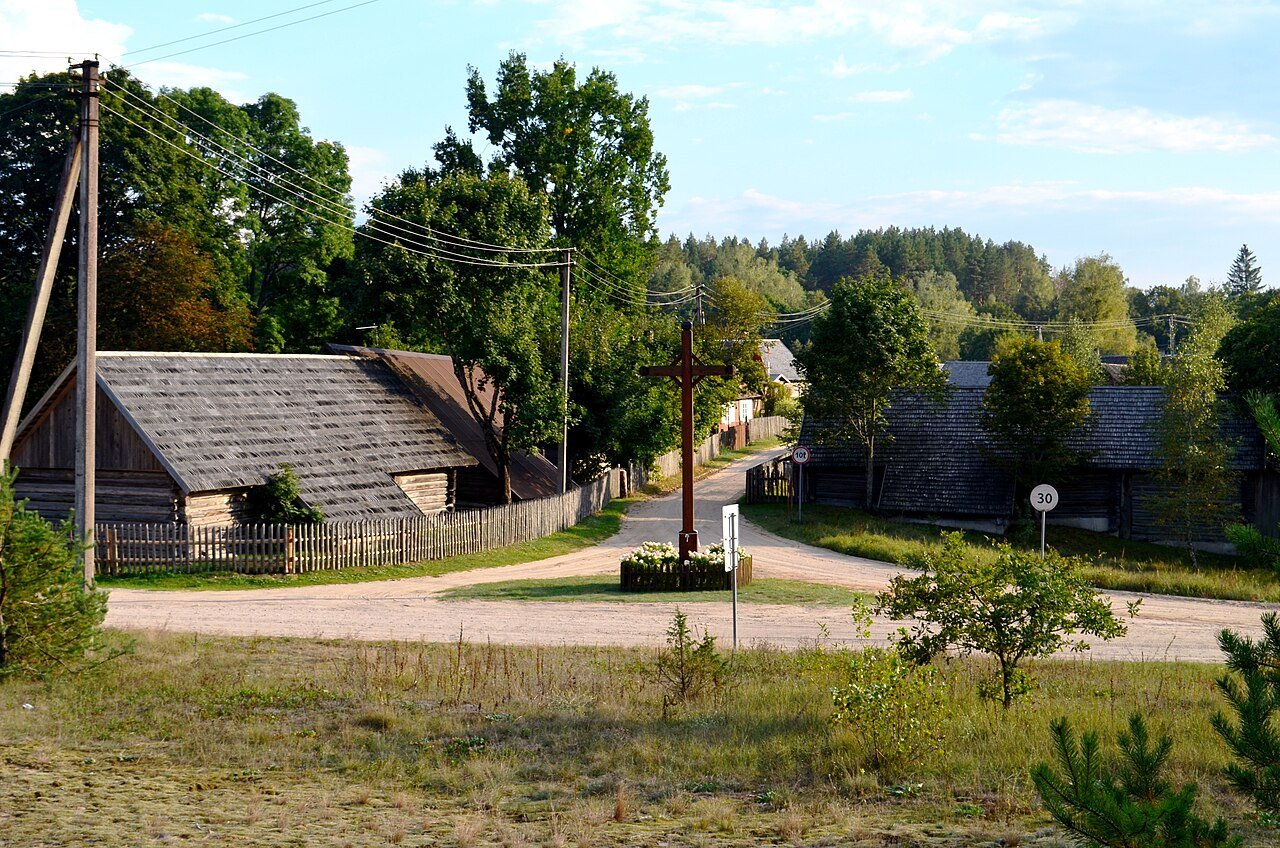
Another common outcome: the village, church or cemetery survives but the exact house does not. Being in the right landscape can still matter even when there is nothing convenient to point at.
And sometimes: the settlement has changed beyond recognition or disappeared. War, occupation, collectivisation, demographic change and urbanisation all altered the rural map.
All three are worth the trip. The third one surprises people by being worth it too — standing in the right field, at the right river, under the right sky, does something that a document cannot.
06 — The emotional part, which nobody warns you about
I'll say this as someone who left this country at twenty and came back at forty-seven: returning to a place your family left is not a neutral activity, and it tends to arrive sideways.
People plan carefully for the archive and not at all for the moment in the cemetery. The emotional moment may be a small detail rather than a grand discovery: a repeated first name, a photograph, a landscape that suddenly makes an old family story physical. Leave room for that possibility without scripting it in advance.
Practical advice, seriously meant: don't schedule the village visit for your last day. Leave a free day after it. Bring someone with you if you can. And build the rest of the trip so it isn't only about records — a sodyba night, a good meal, a lake. You came to meet a country, not just a filing system.
07 — A trip that works
Days 1–2: Vilnius. Land, adjust, walk. If your research needs archive time, this is when it happens — with an appointment made months earlier. See the city guide.
Day 3: the region. Drive to the area, not just the village. Find the church that served it, the market town, the river. Context first; it makes the village mean more when you get there.
Day 4: the village and the cemetery. Allow the whole day and nothing after it. Bring flowers, a camera you can put down, and someone who speaks Lithuanian if there's any chance of conversation with neighbours — local memory can add things no database contains, and a Lithuanian speaker can make those conversations possible.
Day 5: nothing planned. This is the day people need and never book.
Days 6–7: the country. Forest, lake, sauna, food, coast. Meet the living Lithuania as well as the remembered one. The five-day route works as a template.
08 — The cheat sheet
Ten things that make a roots trip work
- Start months out. Archive research, translations and specialist availability are easier when they are not an emergency.
- Mine your own country's records first — manifests, naturalisation papers, census forms and family documents can preserve the place-name or spelling you need to begin.
- Search the surname root, not the surname. Drop the endings, try Cyrillic and Polish renderings, try translations.
- Write to the relevant archive in advance. Give specific names, dates, places and the record you are trying to establish rather than sending an entire family legend as the search query.
- Carry copies of the useful evidence, including old photographs. They are easier to discuss with a local contact than a phone folder containing 3,000 screenshots.
- Take a Lithuanian speaker to the village. Older residents may not speak English, so a Lithuanian speaker can make a village visit far more useful.
- At cemeteries and memorials, follow local/site practice. Flowers or a candle may be appropriate in Lithuanian Christian contexts; Jewish cemetery and memorial customs differ, so do not flatten them into one ritual.
- Ask at the local church. Some records remain outside central digitised collections. Ask the relevant archive or parish what survives before turning up.
- Leave breathing room after the village day. It is a planning recommendation, not an attraction to stack between two timed tickets.
- Book the sauna and the lake too. Come for the dead; leave having met the living country.
09 — What it costs
| Tier | How it works | Cost |
|---|---|---|
| € · Do it yourself | Online records, own research, hire car, translation app, village visits unaccompanied. | Trip cost only |
| €€ · With help | A professional genealogist for the archive work, plus an interpreter for the village day. | Quote required — depends on research depth and language needs |
| €€€ · Fully accompanied | Research done in advance, a suitable driver or interpreter identified for the region days, useful contacts mapped, and the rest of the trip built around it. You book providers directly. | Custom quote — keep research, transport and guiding as separately bookable services |
Do the paperwork now rather than someday. Records last for centuries; the neighbour who remembers your family leaving does not. Start three months early, take somebody who can talk to people over a fence, and — this is the part nobody tells you — leave the day after the village completely empty. You are not planning a fact-finding mission. You are planning for the possibility that a name on a gate takes your legs out from under you at eleven in the morning.
START: three months before you fly · BUILD IN: one free day after the village · VERDICT: go sooner than you planned
Depending on what you need, I can help identify the right genealogist or interpreter, verify the place, map the region day and, where appropriate, be there as your interpreter and local contact. You book providers directly. Ask Vytas — of everything on this site, this is the one where having someone local matters most.