Rooms, collection and published opening hours. Usually the least ambiguous.
MANORS · PARKS · PEOPLE WHO LOST THE KEYS
The aristocrats left. The stories stayed.
Lithuania’s manor houses survived empires, wars, land reform, Soviet schools, agricultural offices and several decades in which nobody could quite agree who should repair the roof. Some now contain museums. Some contain hotel guests. A few contain a locked door and a very fine oak tree.
3,342
recorded manor and folwark sites, fragments and known locations
→
789
placed on a temporary heritage list in 1991
Those numbers do not mean that 3,342 palaces were standing intact. The research included ensembles, fragments and known sites. That distinction matters: in Lithuania, “manor” can mean a furnished museum, a working hotel, an inhabited outbuilding, a park, or stones remembering where the house used to be.
01 · WHAT A MANOR ACTUALLY WAS
Not a large house. A small operating system.
A manor was residence, farm, employer and local service centre at once. Around the main house lived the people who baked, brewed, forged, repaired, gardened, kept horses, managed forests and treated whichever injury had just defeated rural optimism. The elegant façade was only the management screen.
That is why the best visits are not always the grandest buildings. A surviving mill, stable, icehouse, brewery, orchard or avenue can explain the estate better than a ballroom restored so perfectly that nobody is allowed to breathe near the wallpaper.
02 · THE UNCOMFORTABLE PARADOX
Use often saved what reverence could not.
After nationalisation, manor houses became schools, hospitals, libraries, museums, offices, flats and agricultural facilities. Adaptation damaged interiors and erased ownership, but a building with pupils, patients or paperwork still had a roof someone needed. A building without a function had weather.
Occupation did not preserve the manor because it respected the manor. It sometimes preserved the walls because it needed the rooms.
Then independence returned with urgent property questions and little money. Estates had fragmented ownership, residents in former service buildings and no simple route from legal restitution to a repaired roof. Restoration succeeded where ownership, purpose, patience and funding finally met. They did not always arrive in the same decade.
03 · THE PARKS KNOW BETTER
The longest-lived resident may be an oak.
Formal parks announce themselves with axes, clipped geometry and the unmistakable belief that nature performs better under supervision. Landscape parks use winding paths, ponds, framed views and carefully arranged informality. Some once included romantic imitation ruins — artificial decay commissioned for beauty.
History later supplied the genuine article free of charge. Today the park may preserve the clearest shape of a lost estate: an avenue pointing to a house that vanished, a pond that still reflects nothing, or an ancient tree indifferent to whether the person beneath it is a count, collective-farm director or cyclist eating a supermarket pastry.
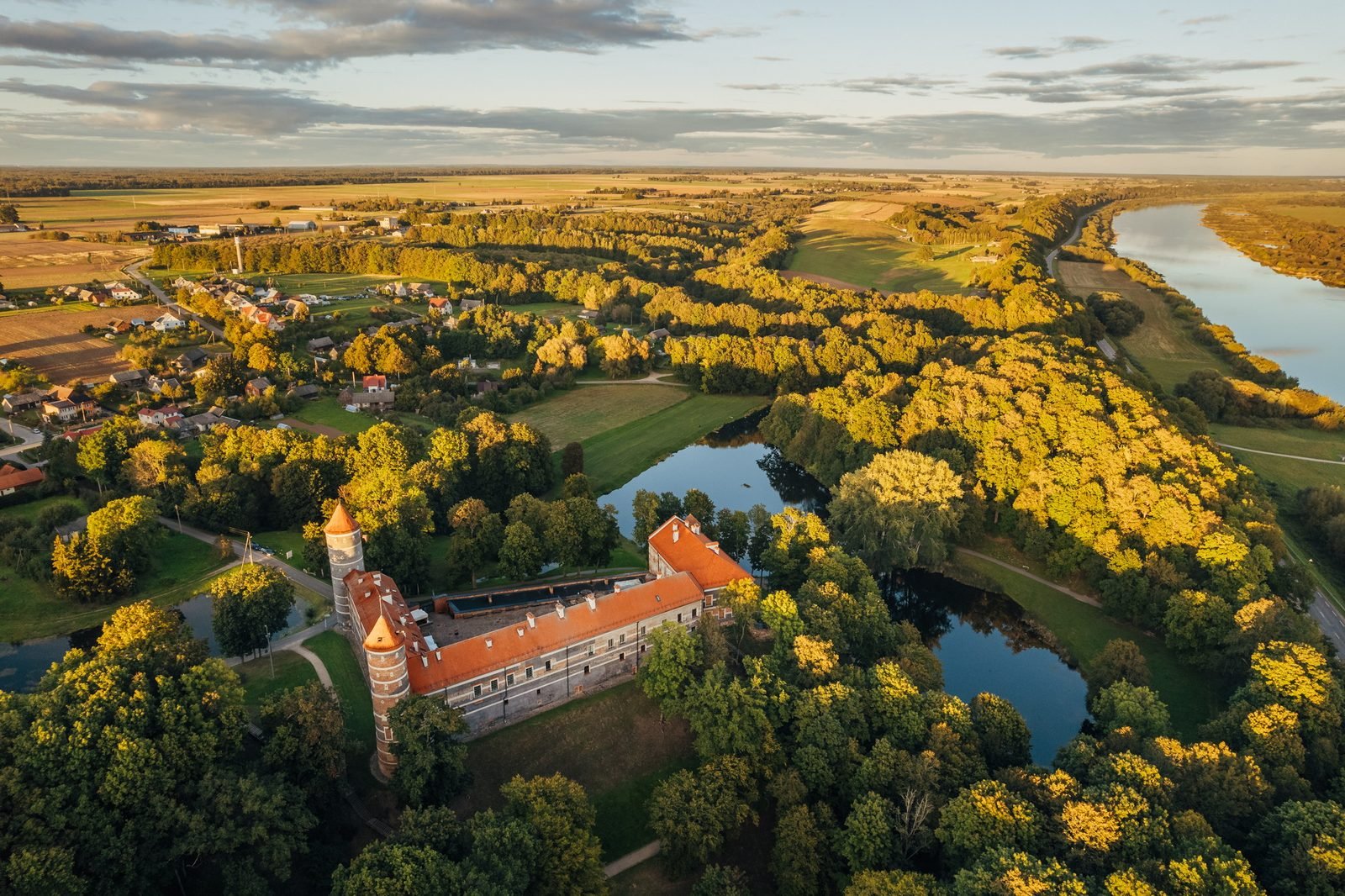
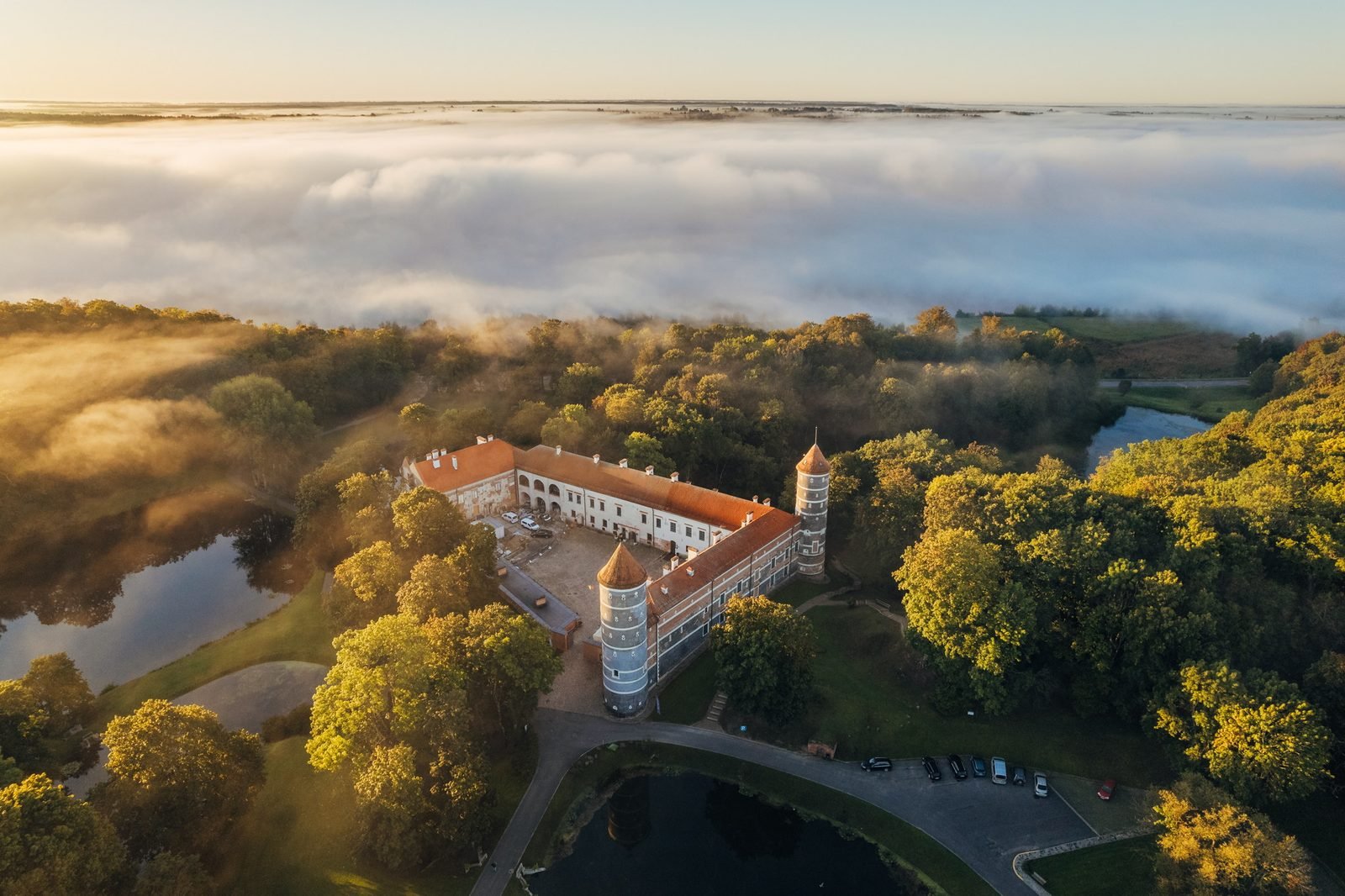
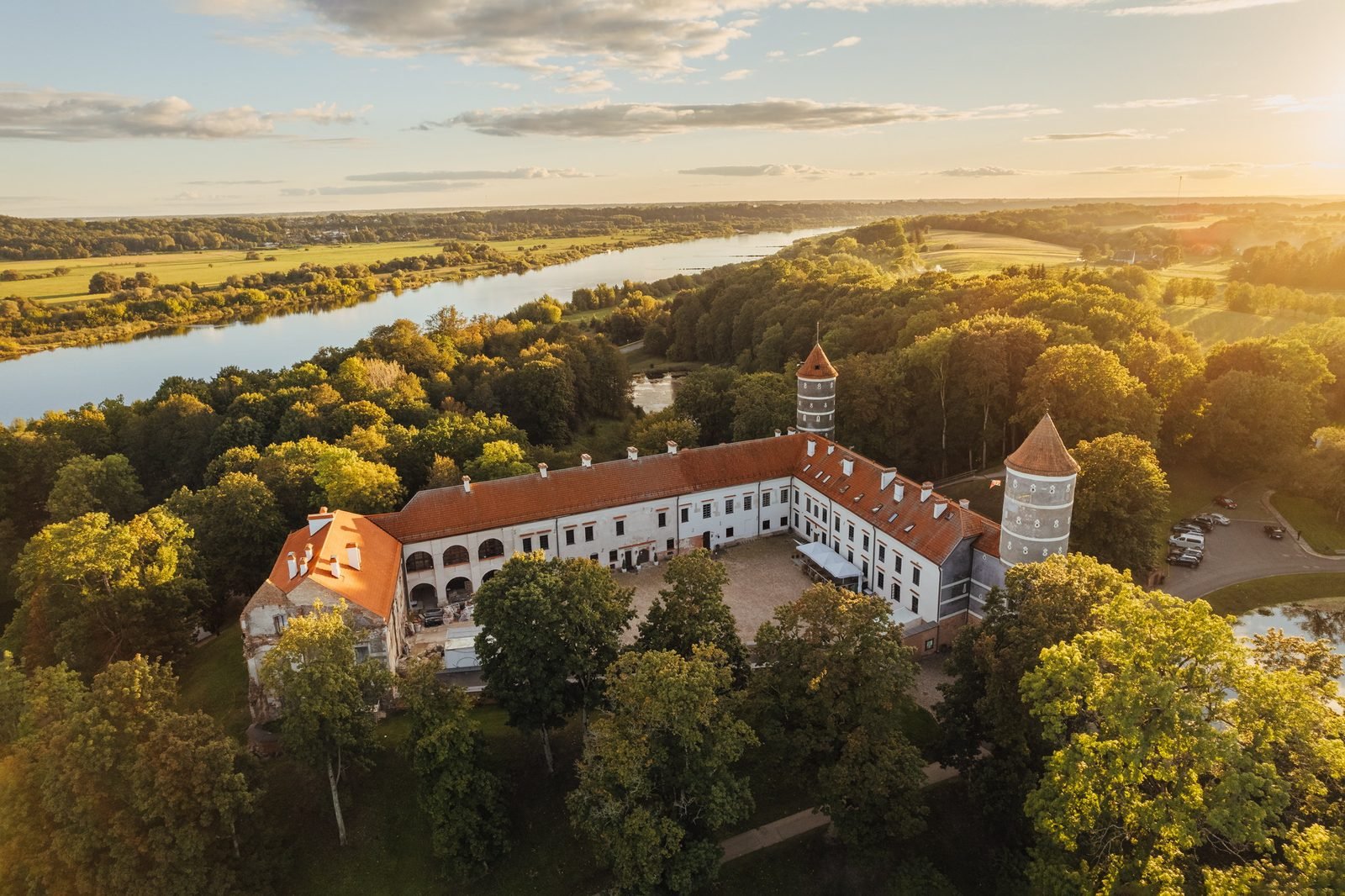
One estate, two explanations: water organised as landscape, and a building that only makes complete sense when seen with the land around it. Photos: Mantas Golubevas / Panemunė Castle, 2025.
04 · READ THE LABEL BEFORE DRIVING
“Visit a manor” means at least seven different things.
The useful question is not “is there a manor?” It is “what can I do when I arrive?”
The interior may open by booking, for groups or at specific times.
The grounds are the experience; the house may be closed or separately managed.
Sleep, eat or use the spa. Heritage interpretation may be secondary.
Concert, festival or wedding venue; ordinary walk-in access may be limited.
Privately restored, changing and often accessible only on announced occasions.
Worthwhile for landscape or history, not for chandeliers or coffee.
05 · THE SHORTLIST
Choose by reason, not by quantity.
Užutrakis
A Tyszkiewicz residence facing Trakai across Lake Galvė, with a landscape by Édouard François André. Go for the relationship between house, terraces, lake and borrowed castle view — not merely another ornate room.
Check official information →Pakruojis
A large working complex turned into an event destination. Its 2026 summer flower festival is a reason to visit in its own right. Come for programme and atmosphere; check which interiors the day ticket actually includes.
Check programme and tickets →Panemunė
Castle rather than manor house in the narrow sense, but essential to the same landscape: park, ponds, river and the long road west from Kaunas. It works best as part of a Nemunas day, not an isolated motorway mission.
Check official information →Raudondvaris
A compact estate with arts, events and a strong visual arrival close to the city. Easy to combine with the Nemunas route and useful when you want heritage without sacrificing the whole day to logistics.
Check events and access →Bistrampolis
Hotel, restaurant, spa, horses, cultural programme and a museum connected with the book smugglers. This is the estate as a functioning destination rather than a façade photographed between petrol stations.
Check rooms and programme →Plungė & Kretinga
Two substantial estates that make sense with Žemaitija rather than as separate trophies. Plungė brings the Oginski world and art; Kretinga adds museum collections and the Winter Garden.
Plungė official site →06 · THE DEEPER DIRECTORY
Twenty-three estates, twenty-three different reasons to stop.
This is the longer layer for people who have already decided that one manor will not be enough. Access labels describe the usual visitor proposition, not a guarantee for a particular Tuesday.
Travel line: approximate road distance from the city centre · VIL Vilnius · KAU Kaunas · KLP Klaipėda. “Allow” is a practical planning range, not a promise: traffic, roadworks, weather and breaks can add time. Check live navigation before leaving.
Near Vilnius
Užutrakis
VIL ~30 km · allow 40–55 min | KAU ~85 km · allow 1 h 20–1 h 40 | KLP ~290 km · allow 3 h 25–4 h
The view was part of the architecture.
Count Józef Tyszkiewicz built the residence at the end of the nineteenth century on a peninsula between Galvė and Skaistis lakes. The park was designed by Édouard François André, but the most extravagant possession was already across the water: Trakai Island Castle, framed like scenery the owners did not need to build. Walk the terraces and shoreline slowly; racing through the rooms misses the estate’s best trick.
Go for: landscape design, lake views and the strongest first introduction to a Lithuanian manor.
Official visitor information →Trakų Vokė
VIL ~20 km · allow 30–45 min | KAU ~95 km · allow 1 h 25–1 h 45 | KLP ~315 km · allow 3 h 45–4 h 20
Eight hundred hectares and a strong opinion about symmetry.
The Tyszkiewicz estate took its nineteenth-century form with architecture and landscape shaped by Italian and French talent. After its last owner died in 1939, war, official use and an agricultural institute replaced family life. That later use altered the house but also kept it occupied. Today the park, façades, cultural programme and continuing restoration are the reasons to watch it rather than assume every room is permanently open.
Go for: a close-to-Vilnius estate with a visible restoration story.
Official programme and access →Liubavas
VIL ~25 km · allow 35–50 min | KAU ~110 km · allow 1 h 35–1 h 55 | KLP ~320 km · allow 3 h 50–4 h 25
The machinery has a better story than another chandelier.
One of Lithuania’s older estates, Liubavas supplied timber and fish to the royal manor in Vilnius in the sixteenth century. Later owners included sculptor Rapolas Slizienis; the estate developed a model stud and a sophisticated water mill. The restored stone mill is the star because it reveals the economic machine behind aristocratic life. This is a compact, content-rich visit rather than a grand palace afternoon.
Go for: engineering, water, sculpture and the working anatomy of an estate.
Official museum information →Tuskulėnai
VIL ~5 km · allow 15–30 min | KAU ~105 km · allow 1 h 30–1 h 50 | KLP ~315 km · allow 3 h 45–4 h 20
A manor whose twentieth century refuses to remain decorative.
The classical palace by the Neris once hosted cultural society, but the estate later became bound to Soviet state violence: victims executed in the NKGB–MGB prison were secretly buried in its grounds. The memorial complex joins manor architecture to occupation history. It is not a romantic country-house stop and should not be marketed as one; its value is precisely the collision between an elegant estate and what happened there later.
Go for: the difficult afterlife of a manor inside the modern city.
Official memorial information →Verkiai
VIL ~12 km · allow 25–40 min | KAU ~110 km · allow 1 h 35–1 h 55 | KLP ~320 km · allow 3 h 50–4 h 25
The easiest manor landscape in the country to reach without a car.
The former episcopal estate occupies one of Vilnius’s finest positions above the Neris. The principal palace no longer survives, so this is not an interiors visit: the remaining classical buildings, park, wooded slopes and river panorama are the experience. City buses bring it within ordinary Vilnius planning, which makes Verkiai more useful to a visitor than many grander estates requiring a hire car and a speech about gravel roads.
Go for: an easy half-day walk, architecture fragments and a panoramic escape from central Vilnius.
Regional park information →Kaunas, Suvalkija & the Nemunas
Raudondvaris
VIL ~110 km · allow 1 h 35–1 h 55 | KAU ~12 km · allow 20–35 min | KLP ~200 km · allow 2 h 25–2 h 50
The low-friction manor: close enough to Kaunas to need no expedition speech.
The red-brick ensemble combines Renaissance inheritance, later rebuilding and the Tiškevičiai period. Its modern strength is use: arts, exhibitions, ceremonies and public events keep the complex active. The compact grounds make it easy to pair with Kačerginė, Zapyškis or the beginning of the Nemunas road. It is a good example of heritage surviving by being useful without pretending to be a sealed time capsule.
Go for: an accessible Kaunas-area stop and a working cultural estate.
Official events and access →Babtynas–Žemaitkiemis
VIL ~126 km · allow 1 h 30–1 h 50 | KAU ~25 km · allow 30–45 min | KLP ~210 km · allow 2 h 30–3 h
Kaunas society once arrived by steamer. The road is easier now.
The estate north of Kaunas has been revived through private ownership, collections and cultural events. Historical accounts of Kaunas intelligentsia travelling by steamer for midsummer gatherings give it something many restored houses lack: a social scene you can imagine making noise. Because it is privately run, treat access as an arrangement or event, not a right produced by arriving at the gate.
Go for: concerts, collections and the lived character of a privately restored place.
Check current events and visits →Zypliai
VIL ~175 km · allow 2 h 25–2 h 55 | KAU ~75 km · allow 1 h 10–1 h 30 | KLP ~170 km · allow 2 h 15–2 h 45
Napoleon’s marshal is the opening line; Suvalkija is the reason to stay.
The estate’s early history is linked with Prince Józef Poniatowski, Napoleon’s marshal, though the present neo-Baroque ensemble grew later. Its modern revival brought galleries, workshops and cultural activity, while nearby Lukšiai and the regional food tradition give the visit a second act. Zypliai works particularly well when combined with Gelgaudiškis or the Nemunas rather than treated as a solitary trophy façade.
Go for: art, craft and a manor day with lunch built into the geography.
Association profile →Belvederis
VIL ~145 km · allow 1 h 50–2 h 15 | KAU ~45 km · allow 45–60 min | KLP ~145 km · allow 2 h–2 h 25
The name promises a beautiful view. History adds an executed entrepreneur.
This Italian-villa-style manor above the Nemunas belonged to the Burba family. Kletas Burba planned what was intended as Lithuania’s first sugar factory and assembled a company involving Bishop Motiejus Valančius; the 1863 uprising destroyed the plan and Burba was executed. Later the estate supported Lithuanian cultural life. Its condition makes it a context-and-exterior stop, not a furnished-palace promise.
Go for: atmosphere, architecture and one of the road’s best interrupted stories.
Association profile →Panemunė Castle
VIL ~171 km · allow 2 h 10–2 h 40 | KAU ~71 km · allow 1 h 5–1 h 25 | KLP ~130 km · allow 1 h 50–2 h 15
Technically a castle; practically indispensable to the manor road.
The residence, park, ponds and Nemunas escarpment operate as one landscape. Its long restoration is visible rather than hidden, which makes repeat visits interesting: the building is not pretending that history stopped on the day the nicest room was completed. Pair it with Raudonė, Veliuona or a slow meal. Three photographs on this page show why the setting matters as much as the interior.
Go for: the strongest visual anchor on the Kaunas–Jurbarkas road.
Official visitor information →Gelgaudiškis
VIL ~177 km · allow 2 h 15–2 h 45 | KAU ~85 km · allow 1 h 20–1 h 45 | KLP ~145 km · allow 2 h–2 h 25
The palace is only half the performance; the park supplies the choreography.
The nineteenth-century classical residence stands beside one of Suvalkija’s most interesting parks, with paths, old trees and views connected to the Nemunas landscape. Guided visits and cultural events are the stronger way to experience it; arriving between programmes may produce more park than palace. That is not a failure when it is planned. Pair it with Zypliai and choose in advance which interior matters most.
Go for: a guided story, a long park walk and a natural second act to Zypliai.
Local visitor information →Paežeriai
VIL ~175 km · allow 2 h 25–2 h 55 | KAU ~80 km · allow 1 h 15–1 h 40 | KLP ~220 km · allow 2 h 50–3 h 20
A proper palace in a region visitors too often treat as road between borders.
The classical manor near Vilkaviškis is associated with the Zabiela and Gawroński families and now houses the Suvalkija regional museum. The ensemble, park and lake setting give it both architecture and context, while exhibitions explain a region usually reduced to agriculture and accents. Paežeriai works best as a deliberate Suvalkija stop rather than an exhausted addition after Kaunas.
Go for: regional history, classical architecture and an underused southern route.
Official museum information →North & east
Paliesius
EASTERN LITHUANIA · make the performance the reason for the detour
A ruined stable became one of Lithuania’s most persuasive reasons to drive east for music.
Paliesius is not a manor to collect between two other stops. Its restored PASAGA hall occupies the former horseshoe-shaped stable and has become a serious classical-music venue; the estate pairs concerts with dinner and overnight stays. That changes the planning logic completely: choose a performance first, then let the manor own the evening instead of racing back to Vilnius after the final note.
Go for: exceptional acoustics, a concert-led rural escape and a manor that works better as an experience than a photograph.
Plan it: programme-led and book-ahead. Do not drive across eastern Lithuania assuming a random Tuesday behaves like festival night.
Official programme, rooms and dining →Pakruojis
VIL ~185 km · allow 2 h 30–3 h | KAU ~150 km · allow 2 h 5–2 h 35 | KLP ~220 km · allow 2 h 55–3 h 25
The manor that decided subtlety was somebody else’s department.
Lithuania’s largest surviving manor complex has become a commercial experience estate with manufactories, restaurants, accommodation and large seasonal productions. In 2026 its summer flower festival runs from late June to mid-September. That scale is its strength and the reason to read the ticket carefully: programme, accessible rooms and event content change. It is closer to a full-day attraction than a quiet museum.
Go for: spectacle, family entertainment and an estate still producing activity.
Official programme and tickets →Burbiškis
VIL ~169 km · allow 2 h–2 h 25 | KAU ~118 km · allow 1 h 40–2 h | KLP ~210 km · allow 2 h 30–3 h
Come for the tulips; stay for the bridges and a manor that remembers how to host people.
This Radviliškis-district estate is the romantic, water-laced counterpoint to Pakruojis. Its park is crossed by bridges and islands, while the house and collections reconstruct early-twentieth-century manor life rather than presenting one polished drawing room and calling the job finished. The annual tulip festival is the famous moment, but poetry events, chamber music and exhibitions give the place a life beyond one spring weekend. Do not confuse it with the different Burbiškis Manor near Anykščiai.
Go for: the park, neo-Romantic atmosphere, tulips and a natural third stop on a northern manor route.
Official museum information →Bistrampolis
VIL ~135 km · allow 1 h 50–2 h 15 | KAU ~115 km · allow 1 h 35–2 h | KLP ~245 km · allow 3 h 5–3 h 35
A country estate that can occupy the evening after the museum closes.
The restored complex combines hotel, restaurant, spa, horses, concerts and a museum telling the story of Lithuanian book smugglers. That mixture makes it useful as a base rather than another pin on a driving day. The heritage rooms are part of a working hospitality business, so judge it by the current stay and programme as well as by the nineteenth-century pedigree.
Go for: an overnight, a performance and a route through central northern Lithuania.
Official rooms and programme →Ilzenbergas
VIL ~185 km · allow 2 h 35–3 h 5 | KAU ~203 km · allow 2 h 55–3 h 20 | KLP ~351 km · allow 4 h 15–4 h 50
The estate still insists that land should produce something.
Ilzenbergas is unusual because the agricultural system is not merely a historical display. The estate has developed around a biodynamic farm, restored buildings, lake landscape and visitor experiences. It is a stronger choice for people interested in food systems and rural production than for anyone counting gilded ceilings. Guided formats and events matter, so plan rather than improvise.
Go for: farm-to-table context, landscape and an estate functioning as an estate.
Official visits and shop →Alanta
VIL ~95 km · allow 1 h 30–1 h 55 | KAU ~120 km · allow 1 h 50–2 h 15 | KLP ~330 km · allow 4 h 5–4 h 40
Granite columns travelled farther than most nineteenth-century visitors.
The Italian-villa-style house was built in 1853; granite columns were shipped from Finland to Klaipėda and hauled inland by oxen. Its rooms once ranged from Louis XIV and Biedermeier to a Chinese-style interior. Military and agricultural education later occupied the estate; today an art gallery provides a public reason to enter. The building itself is a neat summary of imported ambition meeting Lithuanian distance.
Go for: architecture, art and an Aukštaitija detour with a genuinely good transport anecdote.
Association profile →Rokiškis
VIL ~160 km · allow 2 h 20–2 h 50 | KAU ~175 km · allow 2 h 30–3 h | KLP ~340 km · allow 4 h 25–5 h
The manor that turns an entire town axis into part of the collection.
The Tyzenhaus and Przeździecki residence is one of Lithuania’s best-preserved manor ensembles and home to Rokiškis Regional Museum. The approach through the town, estate buildings, park and serious collections make it far more than an isolated house. It also anchors a strong northern route with Ilzenbergas, though attempting both from Vilnius in a casual afternoon is how good places become windscreen scenery.
Go for: a substantial museum, a coherent ensemble and the strongest manor destination in north-eastern Lithuania.
Official museum information →Žemaitija & the west
Plungė
VIL ~285 km · allow 3 h 35–4 h 5 | KAU ~210 km · allow 2 h 40–3 h 10 | KLP ~60 km · allow 50–70 min
Where a future national composer learned inside an aristocratic music school.
The Oginskiai estate is now home to the Samogitian Art Museum. Its cultural importance is larger than the palace: Mikalojus Konstantinas Čiurlionis studied at the estate’s orchestral school, binding aristocratic patronage to Lithuania’s most famous artistic imagination. The park and surviving complex justify time beyond the galleries. Combine it with Plateliai or Kretinga rather than rushing back across the country.
Go for: art, music history and the clearest manor-to-museum transformation in Žemaitija.
Official museum information →Kretinga
VIL ~315 km · allow 3 h 50–4 h 25 | KAU ~220 km · allow 2 h 45–3 h 15 | KLP ~25 km · allow 25–40 min
The palm trees are not a tropical hallucination caused by Baltic rain.
The Tiškevičiai palace houses Kretinga Museum and its celebrated Winter Garden. The glasshouse, collections, mill and park make this one of the easier estates to recommend to a mixed group: architecture enthusiasts can have the history while children and less committed aristocracy collectors have plants and space. It also works naturally with Palanga and the coast.
Go for: the Winter Garden, museum and a reliable bad-weather layer near the Baltic.
Official museum information →Renavas
VIL ~300 km · allow 3 h 55–4 h 30 | KAU ~225 km · allow 2 h 55–3 h 25 | KLP ~105 km · allow 1 h 30–1 h 55
A library, an English park and no requirement to manufacture excitement.
Renavas is among the better-preserved western estates, known for its interiors, library tradition and landscaped park above the Varduva. It rewards the visitor who likes detail and quiet more than spectacle. The setting changes markedly with the seasons; spring flowers and autumn park atmosphere can be as important as the house, but event days and interior hours still need checking.
Go for: an elegant, slower museum stop on a western Lithuania route.
Official museum information →Hugo Šojus
VIL ~303 km · allow 3 h 35–4 h 10 | KAU ~220 km · allow 2 h 50–3 h 20 | KLP ~50 km · allow 50–70 min
A manor that collected the region before the region disappeared.
Hugo Scheu — Hugo Šojus in Lithuanian usage — was a landowner, civic figure and collector whose estate became the foundation of Šilutė’s museum. The value here is not ballroom fantasy but the distinct culture of Lithuania Minor: ethnography, local history and a borderland identity unlike central Lithuania’s Polish-Lithuanian estates. Pair it with Rusnė, Ventė or the lagoon landscape.
Go for: Lithuania Minor and a collector whose curiosity became public memory.
Official museum information →Palanga
VIL ~330 km · allow 3 h 55–4 h 30 | KAU ~240 km · allow 2 h 55–3 h 25 | KLP ~30 km · allow 30–45 min
The country’s most visited manor wears its popularity unusually well.
The Tiškevičiai palace now houses the Lithuanian National Museum of Art’s Amber Museum, surrounded by Birutė Park designed by Édouard François André. The combination is unusually complete for a foreign visitor: a clear collection, readable palace, exceptional park and the sea within walking distance. Crowds are the price of convenience, but the park absorbs them better than Basanavičiaus Street ever could.
Go for: amber, a major designed park and the easiest manor to integrate into a Baltic holiday.
Official Amber Museum information →07 · FOUR ROUTES THAT MAKE SENSE
A manor is better with a landscape around it.
The designed view
Trakų Vokė → Užutrakis → Trakai. Architecture, landscape planning and the most theatrical borrowed view in the country. Check interior times; the parks remain half the point.
The Nemunas road
Raudondvaris → Belvederis → Panemunė → Gelgaudiškis or Zypliai. Do not attempt every gate. Choose two interiors and let the river do the connecting.
Collections and gardens
Plungė → Kretinga → Renavas. Strong museums, parks and stories; better with an overnight stop than a heroic return drive.
The estate as experience
Bistrampolis → Pakruojis → Burbiškis. Stay, programme and seasonal events matter here. Build the route around what is actually happening.
08 · WEDDINGS, CONCERTS & PRIVATE EVENTS
A beautiful gate is not an event plan.
Manors are natural wedding and conference settings because the landscape has already done the decorating. But “hosts weddings” can mean venue-only hire, full catering, accommodation, ceremony rights, or simply that somebody once placed chairs in the park.
Ask about exclusive use, wet-weather capacity, heating, accessibility, sound limits, curfew, catering rules, corkage, power, toilets, parking, guest rooms, taxis and the exact spaces included. Heritage buildings are excellent at romance and sometimes less committed to three-phase electricity.
VENUE STATUS · DESK CHECKED 5 SEPTEMBER 2026
Pakruojis, Bistrampolis and Raudondvaris currently publish event, hospitality or private-hire activity. That is a dated starting point, not a promise for your wedding year. Ownership, restoration, catering and event policy can change; obtain a current written offer directly from the venue before paying a deposit.
I build the shortlist
I compare the places against your date, guest count, accommodation, travel, budget and atmosphere, then find the questions the brochure avoids.
I inspect before you fly
For a separately scoped Local Support assignment, I can visit shortlisted venues, check the real room, access, surroundings and nearby accommodation, document what I find and report independently. I do not receive venue commission and I do not need to make the place look better than it is.
09 · THE CHEAT SHEET
Which one should you choose?
First visit
Užutrakis
Near Vilnius
Trakų Vokė + Užutrakis
Near Kaunas
Raudondvaris
Road trip
Panemunė route
Festival
Pakruojis
Sleep on an estate
Bistrampolis
Art and music
Plungė
Botanical atmosphere
Kretinga
Quiet western detour
Renavas
Wedding scouting
Shortlist by logistics first
THE MANOR NOTEBOOK
This guide is the map. The individual stories come next.
There are too many estates for a dishonest “complete top ten” and too much change for a page written once and abandoned. Future field notes will take one manor at a time: a current photograph, what is genuinely open, the story worth remembering and the practical reason to go now.
Read the latest field notes →VERDICT
Do not collect façades.
Lithuania’s manors are not one attraction repeated twenty times. They are twenty different negotiations between private life, public memory, agriculture, occupation, neglect and reinvention. One is worth entering for the collection, another for lunch, another for a concert, and another because the avenue still knows where the vanished house stood.
The trick is not seeing more manors. It is choosing the right reason to enter each gate.
Reviewed 5 September 2026. Opening hours, private-event closures and seasonal programmes change. Verify the official venue page before making a special journey.
FROM THIS PAGE TO THE WHOLE TRIP
One page solves one decision. The Handbook connects the trip.
Twenty chapters join the days, bases, transport, food, destinations and things worth skipping into one offline plan. If you would rather not assemble it yourself, Trip Build applies the same judgement to your dates.
Trip Build and €99 support both include the complete Handbook at no extra cost.